

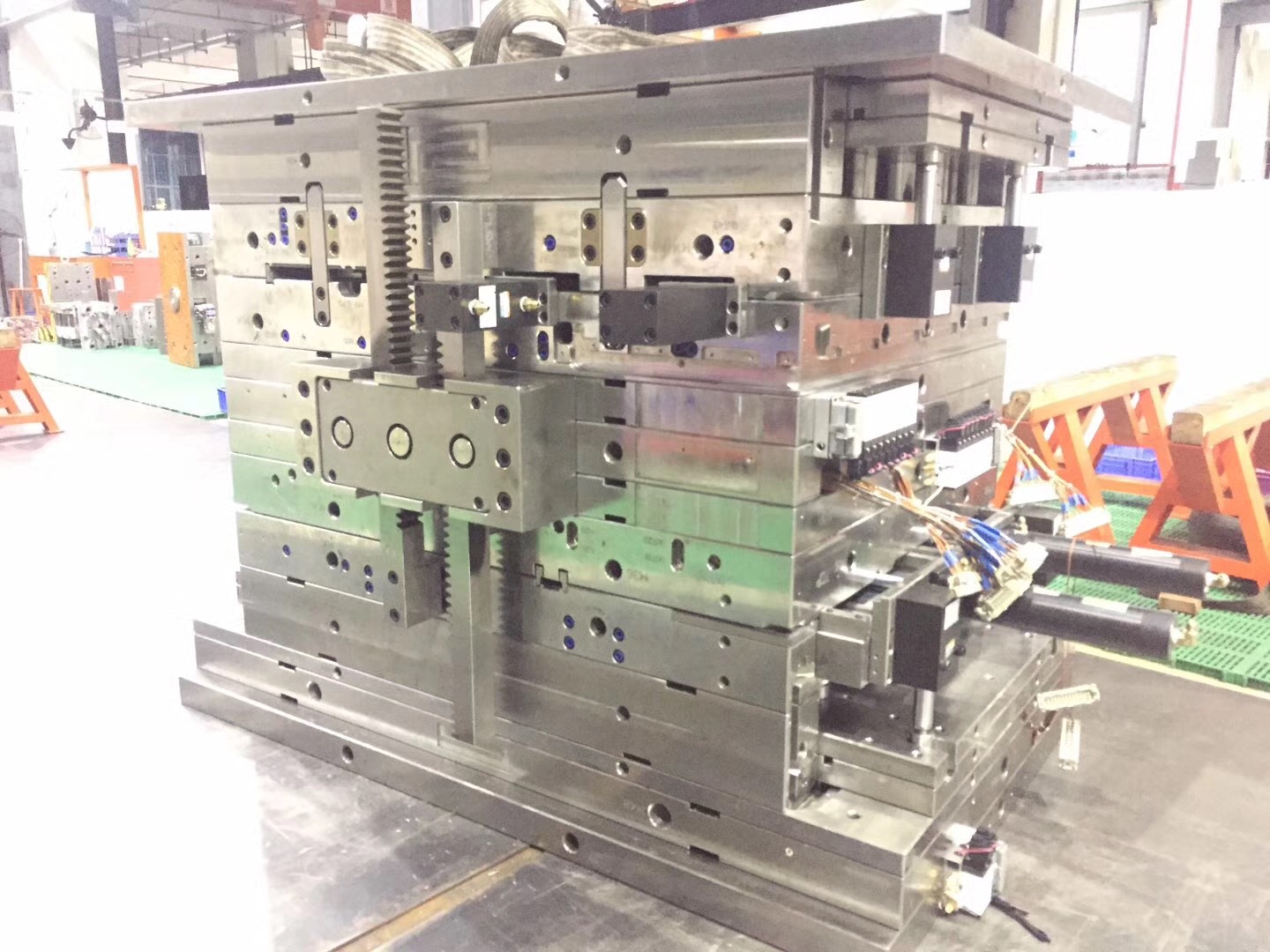
A stack mold increases the number of injection-molded parts produced in one cycle by arranging cavities on multiple molding faces. These faces sit along the machine’s opening direction, creating several parting planes within a single tool.
The approach is particularly relevant to sustained high-volume production. Its value comes from using the available production cell more intensively, but the mold, machine, material-delivery system, and part-handling equipment must be planned together.
How the stack molding cycle works
- Close and clamp the tool. The molding faces close, the center sections are supported and aligned, and the machine establishes the required clamping force. The mold is closed before plastic is injected.
- Fill the molding faces. The melt-delivery system distributes resin to cavities across the levels. Runner and gate design must support the required filling and packing behavior.
- Pack and cool the parts. Pressure and cooling are controlled while the tool remains closed. Each molding face needs suitable thermal control so that one section does not become the limiting factor.
- Open in a coordinated sequence. The mold sections separate with the travel needed for release. The opening mechanism must maintain alignment and provide sufficient clearance for the parts and handling equipment.
- Eject and remove the parts. Ejection and take-out systems clear all relevant molding faces before the next cycle begins.
Hot runner arrangements need special consideration because melt must reach the additional molding faces. EWIKON describes dedicated stack-mold hot runner solutions, including controlled melt transfer to the manifold system.
Higher output and cycle time are different measures
Adding cavities across multiple faces increases the potential number of parts per cycle. It does not automatically shorten the cycle itself. A longer opening stroke, removal sequence, or cooling requirement can add time.
StackTeck notes that the larger machine stroke can account for a cycle-time increase in its stack mold overview. Evaluate production using good parts per hour, including expected downtime and rejected parts, rather than cavity count alone.
The benefits can include higher output from one cell and less additional floor space than installing separate molding cells. Actual savings depend on the complete installation, tool cost, maintenance, labor, and production demand.
Check machine compatibility early
A stack mold may add cavities without requiring a proportional increase in clamping force, as illustrated in a Husky stack molding case study. Clamp suitability still requires an engineering calculation. It must not be selected by cavity count or nominal machine tonnage alone.
The machine review should cover:
- Available mold thickness, opening stroke, daylight, and tie-bar clearance.
- Permitted mold weight and support for moving center sections.
- Shot capacity, injection performance, and plasticizing recovery.
- Cooling connections, hot runner control, and mold-motion interfaces.
- Robot access, ejection clearance, and downstream handling capacity.
Husky’s stack molding application guidance specifically highlights mold support, opening capacity, injection-unit performance, and balanced melt distribution. Check these against the actual machine specification before fixing the tool layout.
Where stack molds fit and where they need caution
Closures, lids, thin-wall containers, and selected medical or laboratory parts are established application areas. Relatively shallow parts are often attractive because they need less opening travel for removal.
Different parts can share a stack tool, but their filling, Kühlung, and production requirements must be compatible. Unequal demand for the parts can also create unnecessary inventory. More molding faces introduce additional alignment, Kühlung, and maintenance responsibilities.
The strongest case for a stack mold is sustained demand that can use the additional output. Evaluate good parts per hour across the complete production cell, with realistic cooling, removal, maintenance, and quality requirements.