


MuCell microcellular injection molding offers a way to reduce plastic part density while addressing some of the shrinkage and packing challenges of conventional molding. The process introduces a controlled amount of gas into the polymer melt, then creates small cells as pressure falls during injection.
For a product team, the useful question is how much weight can be removed while still meeting the actual part specification. Strength, Aussehen, and cost must be evaluated together. MuCell is a registered trademark of Trexel.
How the MuCell process works
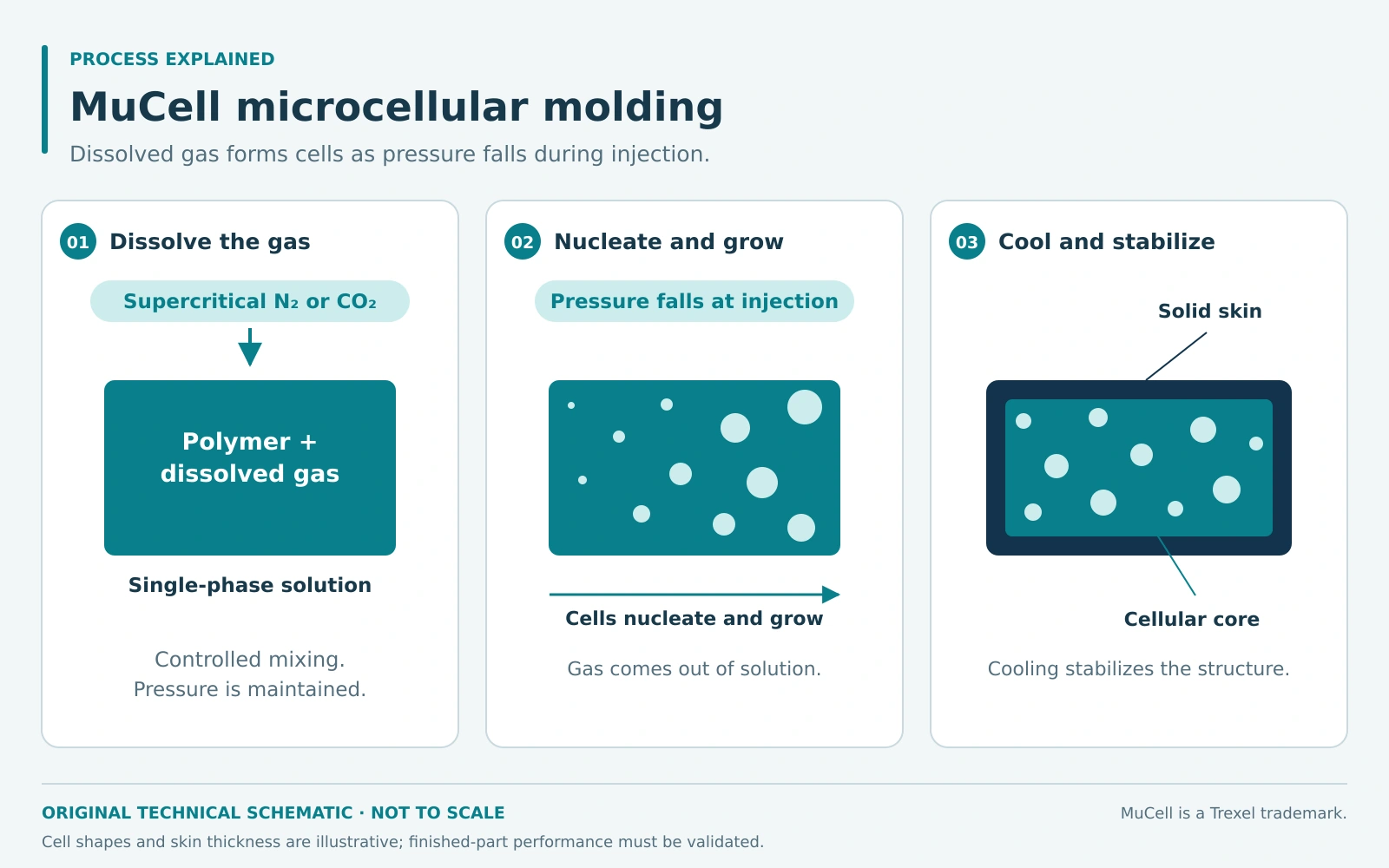
- Meter gas into the melt. Supercritical nitrogen or carbon dioxide is introduced through injectors mounted on the plasticizing barrel.
- Create a single-phase solution. The screw and controlled barrel conditions dissolve and distribute the gas in the molten polymer. Pressure is maintained to avoid premature foaming.
- Inject and form cells. As the material enters the lower-pressure mold cavity, gas comes out of solution and cells nucleate and grow.
- Cool the part. Controlled cell growth provides internal packing. Cooling stabilizes the structure before the component is ejected.
The resulting structure typically has a cellular core and a solid outer skin. Cell size and distribution, skin thickness, resin formulation, and part geometry all matter when evaluating the finished component.
Potential manufacturing benefits
Replacing some solid polymer volume with cells reduces density and can lower resin consumption. Internal cell growth can also reduce the reliance on conventional pack-and-hold pressure, helping address sink and some sources of warpage.
Lower cavity pressure and shorter cycles may be possible in a suitable application. Cycle-time improvement comes from the overall filling, packing, and cooling strategy, rather than simply assuming foamed material always fills faster. Equipment, tooling, resin, and quality requirements determine the achievable result.
Performance limits to validate
Mechanical properties
Weight reduction does not automatically preserve or improve strength, stiffness, or impact resistance. A part can meet its mass target yet have an unsuitable cell structure. Test the molded design under its relevant loads and service conditions, including critical joints, bosses, and weld-line regions.
Compare designs on the basis required by the product. A favorable stiffness-to-weight ratio does not, by itself, demonstrate that absolute stiffness or load capacity meets the drawing.
Surface appearance
Conventional microcellular molding can produce visible streaking, swirl marks, or changes in gloss and color. Reduced sink should not be described as a universal improvement in surface finish.
Specialized approaches, including film decoration, dynamic mold-temperature control, or gas counter pressure, may help meet demanding cosmetic requirements. These add process considerations and need to be assessed as part of the proposed manufacturing route.
Cooling and dimensional stability
Parts need sufficient rigidity before ejection. If residual cell pressure expands a still-soft region after demolding, local swelling, sometimes called post-blow, can occur. Thick sections and poorly cooled areas therefore remain important design-review topics.
The goal is a lighter part that still performs its function. Weight, dimensions, mechanical tests, and appearance should be evaluated together, using a conventional molded design as a meaningful baseline wherever possible.