

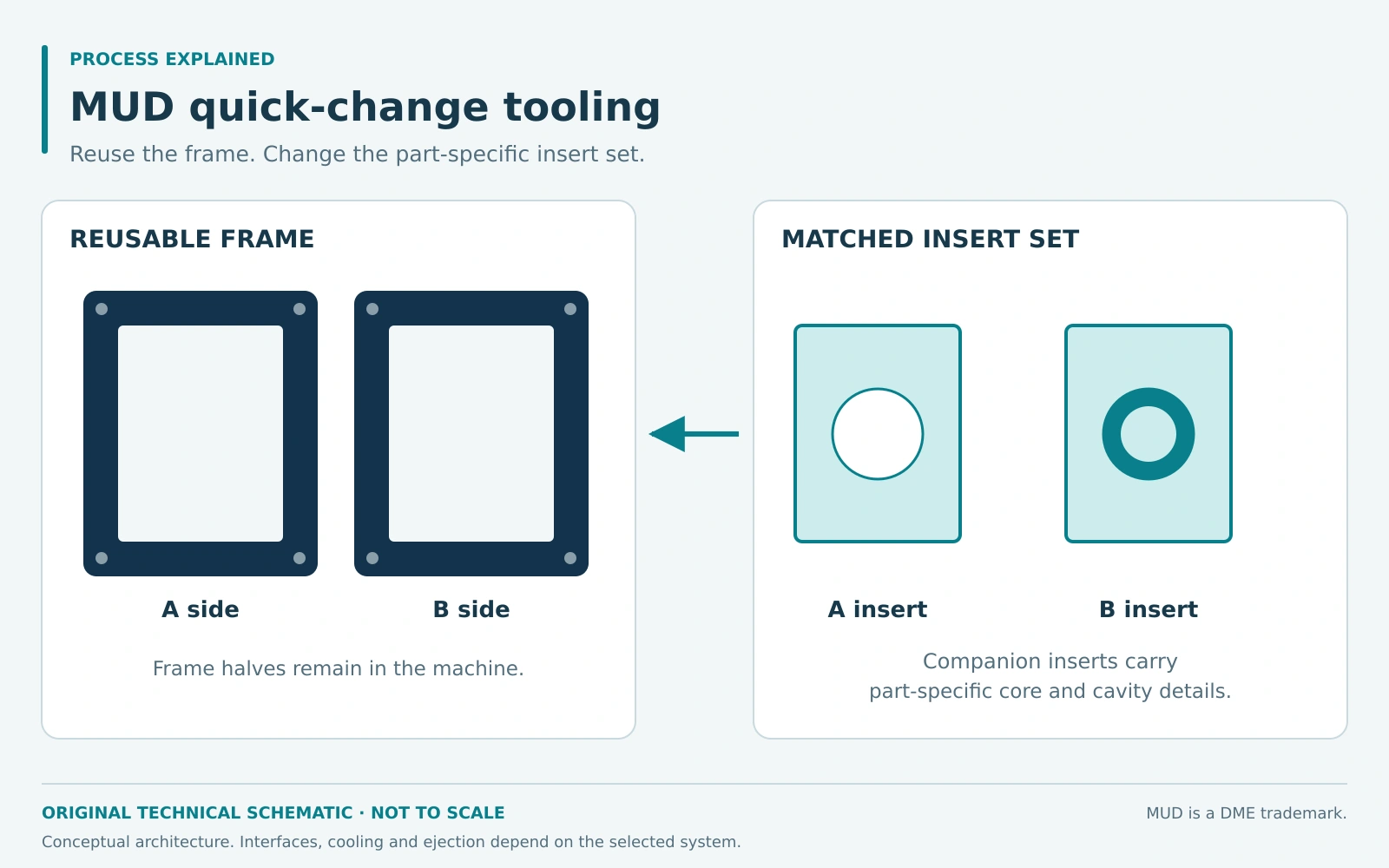
In injection molding, MUD refers to Master Unit Die, DME’s quick-change tooling system. It combines a reusable mold frame with interchangeable insert molds that carry the part-specific geometry. The frame can stay in the molding machine while a compatible insert set is changed.
This modular approach can be useful for prototype programs, short production runs, and production tooling. Its suitability depends on the component, the chosen inserts, and the available frame and machine.
What the frame and inserts do
The common frame provides the base for compatible insert molds. Part-specific core and cavity details may be machined directly into the insert plates or made as separate components fitted into them. The insert set must also accommodate the required molding functions.
DME offers different frame and insert configurations. The correct selection depends on usable molding area, insert thickness, cavity arrangement, and the intended production setup. “MUD compatible” is therefore not a complete tooling specification; the actual interface needs to be identified.
How a quick-change project is developed
- Confirm the platform. Establish the frame type, size, machine fit, and available insert space before detailed tool design.
- Engineer the insert mold. Develop the part geometry together with gates, cooling, venting, ejection, and any moving features.
- Build and fit the inserts. Manufacture the selected metal components and verify their fit and functional interfaces.
- Sample and qualify the tool. Check dimensions, appearance, and process repeatability against the part requirements.
- Plan production changeovers. Document insert identification, connections, setup checks, and maintenance responsibilities.
The quick-change concept reduces how much tooling must be exchanged between compatible jobs. It does not remove the need to qualify a new part or establish its molding process.
Materials and production applications
MUD tooling is metal tooling. DME lists steel and aluminum insert options, with selection depending on the application. Tool life cannot be inferred from the MUD name alone: specify the intended production duty and confirm the proposed insert material and construction.
Prototyping and design iteration are useful applications because changes can be concentrated in the part-specific inserts. Production use is also possible. DME’s catalog includes high-volume applications and multi-insert configurations, so it is inaccurate to describe every MUD mold as a temporary prototype tool.
Benefits and design limits
A shared frame can avoid purchasing a complete new mold base for each compatible project. Interchangeable inserts can simplify changeovers, storage, and maintenance planning. Savings depend on whether a suitable frame already exists and how much custom work the insert requires.
Modularity still leaves practical design choices. DME describes options for cooling connections, hot runners, slides, and specialized ejection. These features must fit the selected configuration; a complicated part may require a different tooling arrangement.
For a purchasing decision, compare the complete package. Include the frame, insert mold, sampling, spare components, maintenance, and expected production costs. A low initial insert price is only one part of the project budget.
MUD describes a tooling architecture rather than a fixed production-life category. The frame interface, insert construction, and molding requirements determine whether a particular configuration suits development work, repeat short runs, or sustained production.