


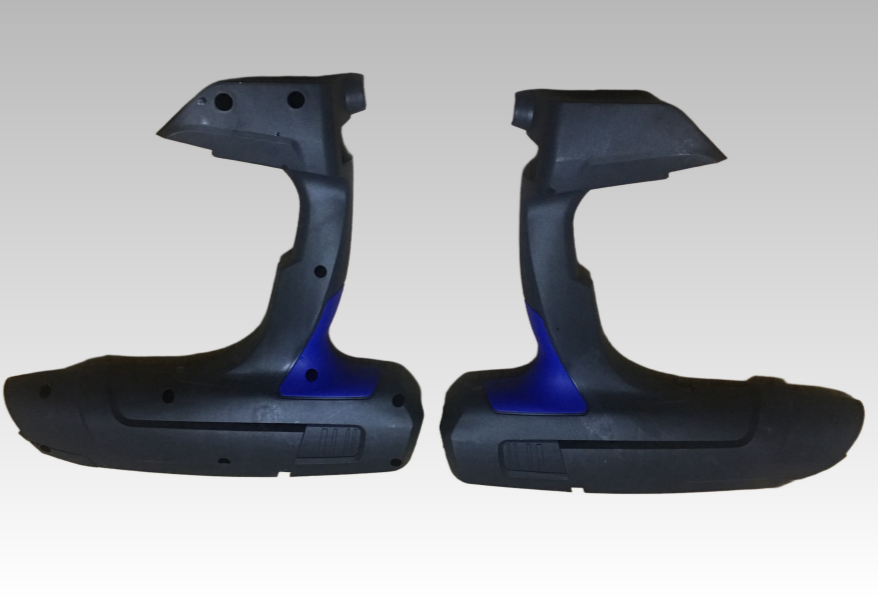
Two-shot injection molding, also called double-shot or 2K molding, combines two materials or colors in one component through a coordinated molding sequence. Examples include a rigid handle with a soft grip, a housing with an integrated flexible feature, or a part with contrasting molded colors.
The strongest reason to choose it is a defined product or manufacturing benefit: integrating a function, reducing assembly, or controlling the relationship between two molded regions. The material pair and interface design are central to that decision.
How the two-shot process works
The first shot forms the substrate or initial region. The tool then presents that first molding to the second-shot cavity, where the next material forms the remaining feature. After sufficient cooling, the completed part is ejected.
Rotary platens are one way to move the substrate, but they are not the only option. Indexing inserts, transfer systems, and core-back tooling can also establish the space needed for the second material. ARBURG’s multi-component overview describes several tooling arrangements. The finished part’s sequence is successive, even when different stations operate concurrently within a production cycle.
By comparison, insert overmolding can use a previously molded substrate loaded into a separate tool. That approach may be worth evaluating when production quantities, material handling, or equipment availability favor a different manufacturing layout.
Confirm compatibility before assuming adhesion
Two plastics do not necessarily bond simply because one is molded onto the other. Adhesion depends on the specific grades, surface condition, processing window, and contact geometry. A thermoplastic elastomer identified only as “TPE” is not enough to establish compatibility with a particular rigid resin.
Obtain a supplier-supported material pairing and test it on representative geometry. Surface contamination and mold-release residues can reduce adhesion, while melt and substrate temperatures influence the result. These factors are discussed in Avient’s TPE overmolding guide. Any temperature adjustment must stay within the guidance for both materials.
Mechanical retention can supplement the interface where suitable. However, a retained soft component still needs application-specific evaluation if it also provides sealing, comfort, abrasion resistance, or another functional requirement.
Design the interface and both flow paths
The first shot must remain located and adequately supported during the second injection. Review the effect of the second material’s pressure and heat on thin substrate areas. Define where the mold closes against the first shot, how each region fills, and where air can escape.
Shut-offs help establish a clean material boundary and prevent the second shot from flowing into unintended areas. Gradual thickness changes, suitable radii, and accessible venting reduce avoidable molding difficulties. Also assess differential shrinkage: a soft overmold can distort a comparatively thin substrate. Avient’s part-design guidance discusses these interface and warpage considerations.
Weigh integration benefits against complexity
Two-shot molding can remove a separate assembly operation and produce repeatable color or material placement. It also adds tooling, material-management, and process-control requirements. A defect in either shot may reject the combined part, so the business case should include yield and validation effort.
Compare complete manufacturing routes rather than molding cost alone. Ask how tooling investment, cycle balance, material changes, inspection, maintenance, and expected demand affect the project. Avoid assuming that the integrated route is automatically the least expensive option.
A successful two-shot component combines suitable materials with a well-supported interface and a balanced molding sequence. Adhesion or mechanical retention should be tested alongside the finished part’s actual function, rather than judged from appearance alone.