


High-temperature injection molding describes the processing of thermoplastics that need elevated melt and mold temperatures, often for parts exposed to demanding service conditions. The processing temperature and the finished part’s allowable operating temperature are separate specifications. A material can tolerate a brief manufacturing cycle at conditions unsuitable for prolonged service.
Successful development therefore begins with the application’s temperature, exposure time, mechanical load, and environment. Choosing a high-performance polymer family is only the beginning; the exact grade and the molded part still need evaluation.
Understand the material families
PEEK, PPS, PEI, and PSU are common candidates for elevated-temperature applications, but they have different structures and property balances. PEEK and PPS are semi-crystalline. Their processing history influences crystallinity, which can affect dimensions and performance. Syensqo’s PPS guidance, for example, connects mold temperature with crystallinity and consistent long-term behavior.
PEI and PSU are amorphous polymers. They soften through a glass-transition region and do not have a sharp crystalline melting point. Processing windows should therefore come from the specific grade’s molding guidance. See SABIC’s PEI material description and Syensqo’s PSU explanation.
Compare candidate grades using relevant temperature-dependent data, including stiffness, creep, chemical resistance, and any application-specific electrical or wear properties. Reinforcement can change strength, shrinkage, and directional behavior. Do not select a filled grade solely from its room-temperature tensile strength.
Control preparation and the molding cycle
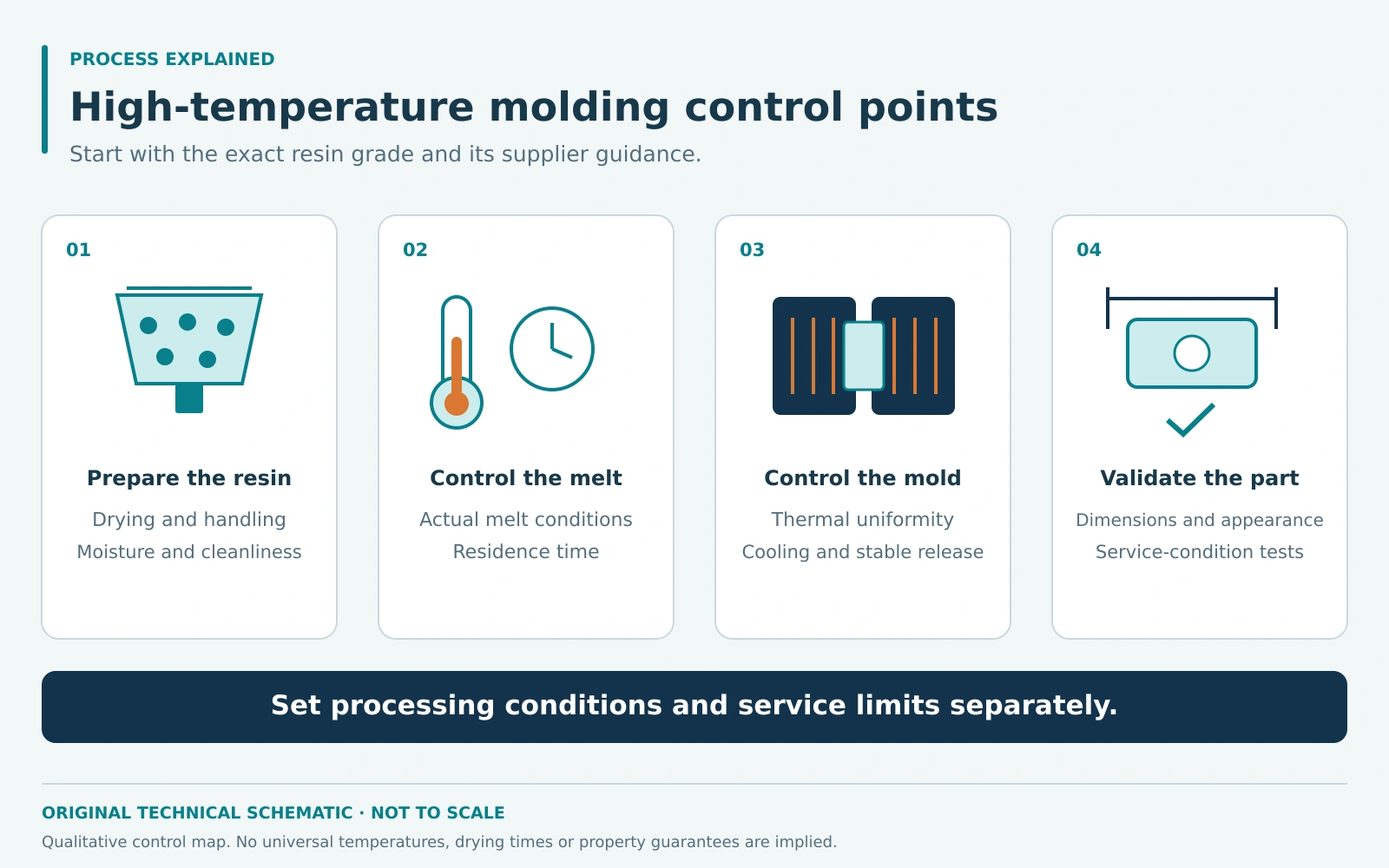
Prepare the resin according to its supplier’s drying and handling instructions. Moisture control and contamination prevention are important even when a material absorbs relatively little moisture. During plasticizing, manage the actual melt conditions and residence time rather than relying on heater settings alone.
The melt fills the tool, is packed, and then releases heat until the part can be ejected without unacceptable deformation. Elevated mold temperature may be necessary to achieve the intended structure or control molded-in stress. The tool does not need to return to room temperature after every shot. Victrex’s injection molding guide explains the importance of drying, equipment suitability, and thermal control for PEEK.
Use grade-specific processing guidance as the starting point for trials. A temperature profile developed for one polymer, filler level, or part geometry should not be copied indiscriminately to another.
Review tooling and part design together
Confirm that the machine, mold-temperature equipment, seals, connections, and handling arrangements are suitable for the intended operating conditions. Tool-material selection must consider wear, corrosion, dimensional stability, and the resin’s requirements. Check alloy compatibility against supplier guidance; a metal suitable for one resin may be unsuitable for another.
For the part, review wall transitions, ribs, gate locations, weld lines, venting, and ejection support. Where dimensional accuracy is critical, identify whether measurements apply immediately after molding, after conditioning, or after service exposure. This makes the acceptance criteria meaningful rather than relying on an unexplained tolerance figure.
Balance performance with cost and validation
High-performance thermoplastics can support demanding functions and component integration. Their benefits still come with trade-offs in resin cost, tooling requirements, process development, and inspection. Heat resistance does not mean a part retains every property indefinitely under every load or chemical exposure.
Plan testing around the expected service conditions. Consider prolonged loading, temperature cycling, contact with actual fluids, and dimensional change where relevant. Establish any post-molding treatment through material guidance and validation rather than assuming it is always necessary or always beneficial.
The useful comparison is between specific resin grades under the intended service conditions. Processing temperature, short-term heat resistance, and long-term performance describe different things; the molded component must satisfy the requirements that matter in use.